| HOME...
A UNIQUE ETHOS » ETHICAL JEWELLERY RESTORATION
Antique
and Heirloom Jewellery Fine Restoration ... Ethically
Kerstin Laibach takes
every available measure to restore anitique and heirloom jewellery
as ethically as possible. By using the same techniques and instruments
with which she makes her collections it is nearly always* possible
to restore pieces without deteriment to the environment. Below
is just one example of her work.
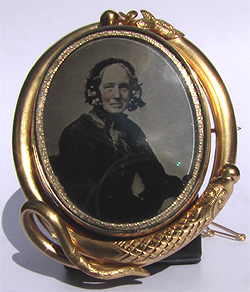
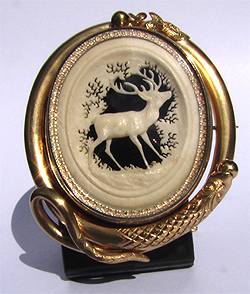
A Victorian swivel
brooch completely restored by Kerstin Laibach.
(Shown with
permission of the owner)
This rare heirloom piece above,
owned by the family of the former Mayor of Winchester in the UK,
is approximately 150 years old. On one side is a deguerreotype
photo and on the other a Black Forest carving. The brooch is likely
to have been made in the Black Forest and was coincidently appropriate
that it should be restored by a goldsmith in the exact same region.
Snake adorned jewellery became popular around 1840 when Prince
Albert gave Victoria an engagement ring in the form of a snake
and this decoration remained popular throughout much of Victoria's
reign.
PRE-RESTORATION CONDITION OF BROOCH:
Various decorative embellishments had previously broken off from
the piece and had been stuck back with glue. The tail of the snake
was broken and subsequently lost. The closing mechanism was damaged,
worn and therefore inadequate. The inner holding oval ring was
also damaged and flimsy. Dirt had accumulated between the photo
glass plates. The glass had also previously been badly cleaned
and appeared misty.
RESTORATION PROCEDURE by Kerstin
Laibach
"After assessing various restore options I concluded that
to achieve the best long-term results for such a potentially important
historical piece, it would be necessary to disassemble all parts,
make new and replace missing, broken or worn parts and reassemble
with hard soldering and re-plate.
Being originally assembled using soft solder (a reason why most
decoration had fallen off and was glued back), it was not practicable
to restore broken sections without hard soldering. It therefore
made more sense to restore and replace the parts using hard solder.
This has now provided long-lasting strength to the entire piece.
To restore the surface of the brooch it has been substantially
re-plated with 14ct gold*. I have made a new snake tail in 9ct
gold and also a new closing mechanism in 9ct gold, which will
ensure that such areas, where gold plating would otherwise wear
down, should enable occasional wear without detriment to the appearance
of the entire piece. The new closing mechanism (aesthetically
made identical to the original) should also ensure that the brooch
can be worn safely without risk of falling off.
I dismantled the sandwiched glass of the daguerreotype and carefully
re-polished to restore the original detail of the picture."
* Kerstin Laibach does
not plate her own jewellery creations (further
information here). However,
restoration of old pieces may call for re-plating: On rare
occasions where the base metal of a piece of a restoration piece
is not gold it may be necessary to re-plate (gold-plate)
back to its original finish. On such occasions, the piece is sent
to a dedicated plating company which has the appropriate
plating equipment to coat the piece with the least environmental
impact. Atelier Laibach is currently searching for a plating a
company which uses only recycled gold coating throughout its plating
process. So far there appears to be none in existence.
What
is the difference between recycled gold and new-mined gold?
MORE
INFORMATION ...
Repair,
Restoration, Redesign, Recycle, Reclaim Service Main Page
Rejuventaion
of Old, Worn Wedding Rings
Read
more about the ten year / pre-millennium threshold principle
Repair
and Restore - Extending a Respect for what our Planet has Provided
in the Past
Creating
pieces from your own gathered pebbles
|



 Only
recycled precious metals and not directly mined and therefore
no further displacement of fragile eco-systems.
Only
recycled precious metals and not directly mined and therefore
no further displacement of fragile eco-systems.